- Your cart is empty
- Continue Shopping


Product Description
(main product page content)
Most training programmes fail. Not because of the effort put in. Because of how they’re designed.
The athlete training 5 sessions per week, working genuinely hard, and barely progressing past their initial beginner gains is not failing for lack of dedication. They are failing because of programme design errors that are both common and correctable: no structured progression, no periodisation, no recovery management, and no understanding of the adaptation mechanisms that determine whether training produces results or just produces fatigue.
The Training Blueprint is the evidence-based framework for getting it right — from the cellular mechanisms of muscle adaptation to complete 12-week programming, built for serious amateur athletes, competitive amateurs, and developing semi-professionals who train with intent.
—
What’s Inside
9 chapters. 65+ pages. A complete training science system.
Chapter 1 — The Science of Adaptation The General Adaptation Syndrome and supercompensation cycle. Muscle hypertrophy at the cellular level — myofibrillar vs sarcoplasmic, mechanical tension, metabolic stress, and muscle damage. Neural adaptations: motor unit recruitment, firing rate, inter-muscular coordination. Connective tissue adaptation timelines — and why they lag behind muscle and cause overuse injuries when ignored. The overtraining vs overreaching distinction.
Chapter 2 — Programme Design Fundamentals The primary training variables: volume, intensity, frequency, exercise selection, rest periods. Volume landmarks: MV, MEV, MAV, MRV — and how to use them for intelligent programme design. Reps in Reserve (RIR) as a practical intensity metric. The minimum effective dose concept. Auto-regulation approaches for daily performance variation.
Chapter 3 — Periodisation Systems Linear periodisation — structure, application, limitations. Daily and weekly undulating periodisation (DUP/WUP) — the evidence-based superior approach for intermediate to advanced athletes. Block periodisation — concentrated development for advanced athletes. Conjugate periodisation — simultaneous max effort and dynamic effort development. The mesocycle as the practical programming unit.
Chapter 4 — Strength Development The neuromuscular basis of maximal strength. The back squat, deadlift, overhead press, and bench press — technical framework for each. Programming for maximal strength: loading schemes, wave structures, and progression methods. Strength standards for athletic development with bodyweight benchmarks.
Chapter 5 — Power, Speed, and Explosiveness Rate of force development — the mechanism underlying all explosive athletic performance. Plyometric training: classification, dosing, and progression. Olympic lift derivatives: hang power clean, hang power snatch, and their application to non-weightlifting athletes. Ballistic training: jump squats, medicine ball throws, and their role in force-velocity continuum development.
Chapter 6 — Conditioning and Energy Systems The three energy systems in detail: alactic (PCr), lactic (glycolytic), and aerobic. Training protocols for each system. The interference effect — the science of managing concurrent strength and conditioning training to minimise adaptation conflict. Conditioning modality selection by sport and recovery considerations.
Chapter 7 — Mobility, Stability, and Injury Prevention The joint-by-joint approach. Movement assessment: overhead squat, hip hinge, and key mobility screens. Primary mobility targets for strength and power athletes: ankle, hip flexors, hip external rotation, thoracic extension, shoulder. Acute:Chronic Workload Ratio (ACWR) monitoring for injury risk management.
Chapter 8 — Recovery Integration Sleep as the primary recovery mechanism — growth hormone, motor skill consolidation, and the 8-hour performance standard. Post-training nutrition timing. Active recovery modalities. Cold and heat therapy: evidence, limitations, and strategic use. HRV monitoring for daily training adjustments.
Chapter 9 — The 12-Week Athletic Training Plan Three complete mesocycles: Hypertrophy Foundation (Weeks 1–4), Strength Development (Weeks 5–8), Power and Sport-Specific (Weeks 9–12). Sample weekly schedules, loading parameters by phase, deload protocols, and adaptation progression criteria.
Appendix A — Training Logs and Trackers Weekly Training Log · 12-Week Progress Tracker · HRV and Recovery Log · Mobility Assessment Tracker
Appendix B — Exercise Reference and Quick Cards The 8 Training Principles · Energy System Training Quick Reference · Deload Week Protocol · Key Numbers Quick Reference (protein, sleep, volume, rest periods, ACWR)
—
Who This Is For
- Serious gym athletes who want to train with genuine scientific understanding
- Competitive amateurs across strength sports, team sports, combat sports, and individual athletics
- Athletes who have plateaued and need to understand why and how to break through
- Anyone who has followed other people’s programmes without understanding the principles — and wants to be able to design and adjust their own
- Self-coached athletes building a systematic athletic development approach
—
The Science Behind It
The Training Blueprint draws on:
- Brad Schoenfeld’s hypertrophy research synthesis and meta-analyses
- Zatsiorsky and Kraemer’s Science and Practice of Strength Training
- Tudor Bompa and Vladimir Issurin’s periodisation frameworks
- Mike Israetel and colleagues’ volume landmark framework
- Gary Klein’s naturalistic decision-making applied to training
- Cheri Mah’s athletic sleep performance research (Stanford)
- Multiple meta-analyses on volume-hypertrophy dose response (Krieger, Ralston, Schoenfeld)
—
What You Get
✓ 65+ page PDF — immediate download ✓ 9 chapters of training science and evidence-based protocols ✓ Complete 12-week progressive training plan ✓ Printable training logs and trackers (Appendix A) ✓ Exercise reference and quick cards (Appendix B) ✓ Comprehensive glossary of 23 training science terms ✓ Evidence grades for all major training recommendations ✓ Guide 1 of 4 in the Athletic Performance Series
—
The Athletic Performance Series
Guide 1 — The Training Blueprint (this guide) Programme design, periodisation, strength, power, conditioning, recovery integration
Guide 2 — The Athlete’s Nutrition Code (coming soon) Fuelling for performance, body composition, sport-specific macros, timing
Guide 3 — The Recovery Protocol (coming soon) Sleep architecture, active recovery, HRV management, periodised deload, burnout prevention
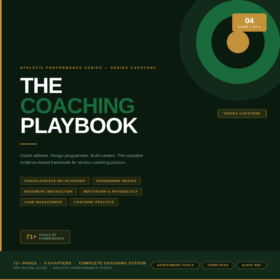
Guide 4 — The Coaching Playbook (coming soon) Coaching methodology, athlete psychology, programme design for others
—
This guide is for informational and educational purposes only. It does not constitute medical advice. Consult a qualified healthcare professional or certified strength and conditioning specialist before beginning any new training programme.
Only logged in customers who have purchased this product may leave a review.


Reviews
There are no reviews yet.