- Your cart is empty
- Continue Shopping


Product Description
Training creates the potential. Recovery creates the adaptation.
Most athletes spend enormous effort optimising their training and nutrition while treating recovery as an afterthought. The consequence is predictable: stalled progress, accumulating fatigue, increased injury risk, and eventually the burnout that forces the rest they refused to take voluntarily.
The Recovery Protocol addresses the other side of the adaptation equation — the sleep architecture, HRV monitoring, active recovery, deload planning, and psychological recovery practices that determine whether training stimulus produces its full adaptive potential or simply produces fatigue.
—
What’s Inside
9 chapters. 68+ pages. A complete athletic recovery system.
Chapter 1 — The Physiology of Athletic Recovery The supercompensation cycle in full detail. Muscle protein turnover and MPS timing. Inflammatory resolution — why acute inflammation is adaptive and how to support rather than suppress it. Glycogen resynthesis kinetics and the two-phase window. ANS recovery and what drives it. Recovery timelines by system: from PCr (3–5 minutes) to connective tissue (72+ hours).
Chapter 2 — Sleep Architecture for Athletes The 90-minute sleep cycle structure. Slow-wave sleep (NREM 3–4): growth hormone secretion, tissue repair, glymphatic clearance — and why you lose this first when you sleep less. REM sleep: motor skill consolidation, emotional processing, neural restoration. Why 8 hours is the minimum effective dose for athletes under load, and why 9–10 hours is optimal. Sleep debt and why athletes become subjectively unaware of their own impairment.
Chapter 3 — Sleep Optimisation Protocols Circadian rhythm anchoring through morning light. The 90-minute pre-sleep wind-down protocol in full detail — from T-90 minutes to bedtime. Sleep environment optimisation: temperature, light, sound, and the phone in the bedroom problem. Strategic napping: 20-minute vs 90-minute nap protocols and their different recovery applications.
Chapter 4 — HRV Monitoring and Training Readiness How HRV works and what it actually measures. Consistent measurement protocols — why morning, supine, before rising is the gold standard. Interpreting HRV relative to personal baseline — the 10% rule. HRV devices: WHOOP, Oura Ring, Garmin compared. Building your personal HRV baseline over 14 days. Using HRV trends across the training week and mesocycle.
Chapter 5 — Active Recovery Modalities Evidence hierarchy for active recovery interventions. Low-intensity aerobic recovery — the highest evidence, lowest cost, most accessible modality. Foam rolling: what the evidence actually shows and the correct 60–120 second protocol. Professional massage: optimal timing at 48 hours post-heavy session. Percussion massage devices and their place in the evidence hierarchy.
Chapter 6 — Deload Strategy and Periodised Recovery The physiology of the deload — the fitness-fatigue model and why deloads produce performance peaks. Volume deload, intensity deload, and frequency deload: when each is appropriate. Deload timing: scheduled vs HRV-triggered. Annual recovery planning — the post-season extended recovery that weekly deloads cannot replace.
Chapter 7 — Cold, Heat, and Contrast Therapy Cold water immersion: evidence, protocol, and the adaptation interference caveat for hypertrophy athletes. When to use CWI and when to avoid it. Sauna: the growing evidence base, hormonal response (16× growth hormone increase), plasma volume expansion, and the 15–20 min post-training protocol. Contrast therapy: the middle path with specific competition-period applications.
Chapter 8 — Psychological Recovery and Burnout Prevention The psychology of athletic fatigue — why psychological markers precede physiological overtraining by 2–4 weeks. The 5-item daily psychological readiness check. Burnout prevention: protecting intrinsic motivation, maintaining training autonomy, managing the perfectionist self-evaluation that accelerates depletion. Social connection as a recovery variable.
Chapter 9 — The 8-Week Recovery Integration Plan Four progressive phases: Sleep Foundation (Weeks 1–2), HRV Integration (Weeks 3–4), Thermal and Active Recovery (Weeks 5–6), Integration and Optimisation (Weeks 7–8). The complete daily and weekly recovery schedule. 12-week periodisation and recovery calendar template.
Appendix A — HRV Logs and Recovery Trackers Daily HRV and Recovery Log · Weekly Psychological Recovery Rating · 8-Week Recovery Progress Tracker · Deload Planning Template · Recovery Self-Assessment Daily Check-In
Appendix B — Recovery Quick Reference Cards The 8 Recovery Principles · Thermal Therapy Quick Reference · Active Recovery Day Template · Evidence Grades Summary · Recovery Supplement Stack · Key Numbers Quick Reference
—
Who This Is For
- Serious athletes who train hard but plateau, accumulate fatigue, or experience recurrent injuries
- Anyone who wants to understand what actually happens during recovery — not just that rest is important
- Athletes implementing The Training Blueprint and Athlete’s Nutrition Code who want the recovery layer that completes the system
- Coaches building recovery protocols for athletes they train
- Anyone experiencing the warning signs of overtraining: stalled performance, suppressed motivation, disrupted sleep, persistent fatigue
—
The Science Behind It
The Recovery Protocol draws on:
- Cheri Mah’s Stanford athletic sleep extension research
- Bannister’s fitness-fatigue model and supercompensation theory
- HRV monitoring research: Plews, Kiviniemi, Boullosa
- Matthew Walker’s sleep science synthesis
- Laukkanen et al.’s sauna-recovery research
- Bleakley and Versey meta-analyses on cold water immersion
- POMS (Profile of Mood States) overtraining monitoring research
- Sara Mednick’s strategic napping research
—
What You Get
✓ 68+ page PDF — immediate download ✓ 9 chapters of recovery science and evidence-based protocols ✓ Complete 8-week recovery integration plan ✓ HRV baseline establishment protocol ✓ Printable logs, trackers, and planning templates (Appendix A) ✓ Quick reference cards (Appendix B) ✓ Overtraining diagnostic framework ✓ Athlete case studies ✓ Guide 3 of 4 in the Athletic Performance Series
—
The Athletic Performance Series
Guide 1 — The Training Blueprint (available now) Programme design, periodisation, strength, power, conditioning, 12-week plan
Guide 2 — The Athlete’s Nutrition Code (available now) Macronutrient strategy, timing, body composition, sport-specific nutrition, supplementation
Guide 3 — The Recovery Protocol (this guide) Sleep architecture, HRV monitoring, active recovery, deload strategy, burnout prevention
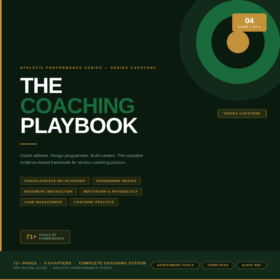
Guide 4 — The Coaching Playbook (coming soon) Coaching methodology, athlete psychology, programme design for others
—
This guide is for informational and educational purposes only. It does not constitute medical advice. Consult a qualified sports medicine professional before making significant changes to your training or recovery practices.
Only logged in customers who have purchased this product may leave a review.


Reviews
There are no reviews yet.