- Your cart is empty
- Continue Shopping


Product Description
(main product page content)
Stress isn’t the problem. A dysregulated stress response is.
The human stress response system is exquisitely designed to handle acute, bounded challenges. It is not designed for the relentless, low-grade, never-fully-resolving activation of modern life — the emails, the deadlines, the financial pressure, the background noise that never fully turns off.
Chronic HPA axis dysregulation — the physiological signature of modern chronic stress — produces cortisol rhythm disruption, hippocampal damage, immune suppression, metabolic dysfunction, sleep impairment, and the progressive erosion of cognitive and emotional capacity. These are not minor inconveniences. They are documented neurobiological consequences with measurable long-term health costs.
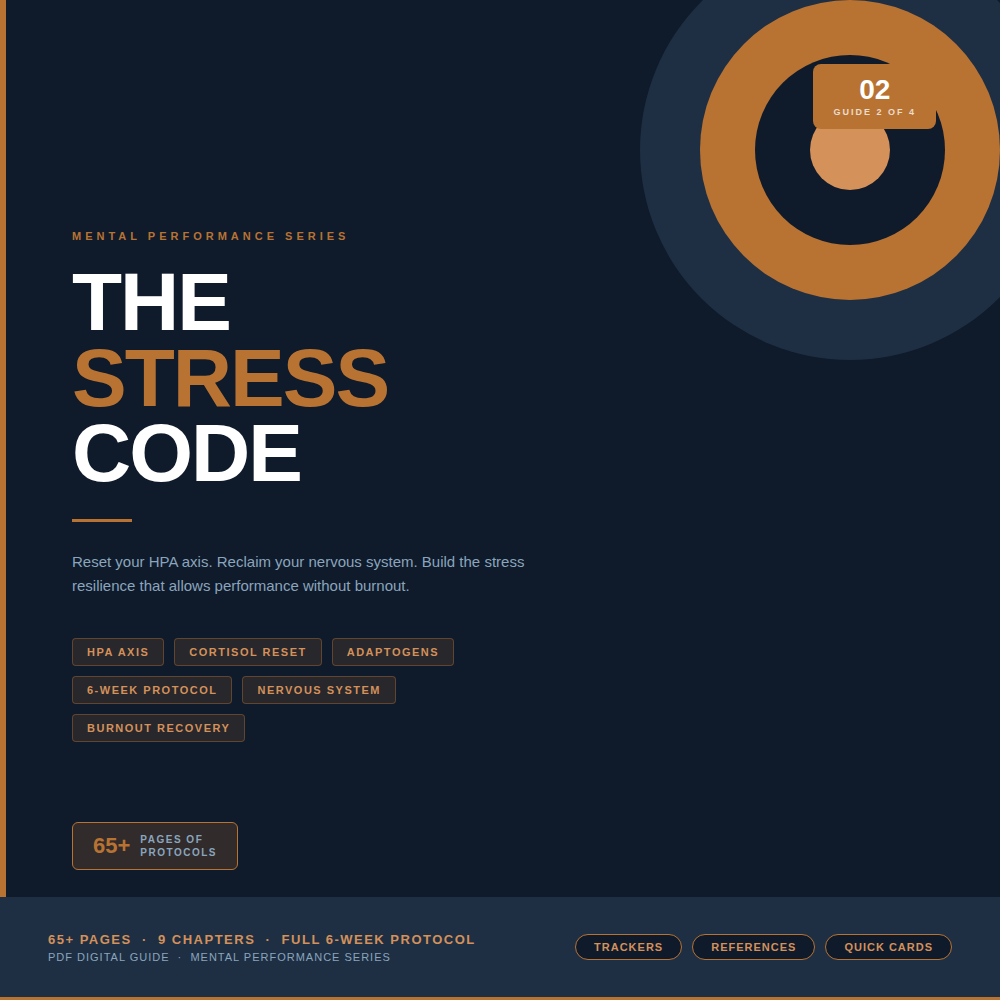
The Stress Code is a systematic, evidence-based protocol for recalibrating the HPA axis from the ground up — targeting the stress response system at every level it operates and providing the tools to restore it to its design specification: responsive when needed, recovered when not.
—
What’s Inside
9 chapters. 65+ pages. A complete recalibration system.
Chapter 1 — The HPA Axis: Your Stress Operating System The complete three-stage stress cascade (hypothalamus → pituitary → adrenal), the negative feedback loop that terminates the stress response, the diurnal cortisol rhythm, and what goes wrong under chronic activation. The allostatic load concept and why cumulative stress burden matters.
Chapter 2 — Cortisol: The Double-Edged Hormone Cortisol’s essential functions (energy mobilisation, immune regulation, cognitive modulation) and its pathological effects when chronically dysregulated. The Yerkes-Dodson application to cortisol and performance. Symptom mapping to identify your personal cortisol pattern — elevated, flattened, or dysrhythmic.
Chapter 3 — Chronic Stress and the Brain The stress-neuroplasticity paradox: why acute stress builds resilience and chronic stress destroys it. Hippocampal atrophy and how it reverses. Amygdala hypertrophy and the threat amplification loop. PFC impairment and why stressed people make worse decisions. The good news: these changes are largely reversible.
Chapter 4 — The Nervous System Reset Protocol Heart rate variability as the autonomic health marker. The complete breathing protocol toolkit: physiological sigh (immediate acute stress reduction), 4-7-8 breathing, box breathing, and resonance frequency breathing (10 minutes daily for HRV improvement). Cold exposure protocols. Exercise prescription for HPA recalibration. Vagal nerve stimulation approaches.
Chapter 5 — Sleep, Recovery, and Stress Recalibration The cortisol-sleep interface: why elevated evening cortisol prevents both sleep onset and adrenal recovery. Sleep architecture for stress recovery — slow-wave sleep as the primary cortisol recalibration window. The evening wind-down protocol in full detail. Progressive muscle relaxation. Consistent wake time as the diurnal rhythm anchor.
Chapter 6 — Stress-Protective Nutrition & Supplementation Anti-inflammatory eating for HPA support. Blood sugar stability as a stress management tool. Evidence-graded supplementation: Ashwagandha (up to 27% cortisol reduction in RCTs), Rhodiola Rosea, Magnesium L-Threonate/Glycinate, Phosphatidylserine, L-Theanine, and high-potency B-complex. Adrenal-specific nutrients: Vitamin C, B5, Zinc.
Chapter 7 — Psychological Stress Management Cognitive reappraisal: the most evidence-based emotion regulation strategy for durable cortisol reduction. Rumination management and the written expression protocol. Stress inoculation training. Values clarification as an HPA axis intervention. Self-compassion as a cortisol management tool.
Chapter 8 — The Social and Environmental Stress Load Social stress as HPA activator. Relationship quality and cortisol buffering. The digital environment as a chronic stress source. The information diet as stress management. Physical environment stressors: noise, commuting, and the evidence for nature exposure (20 minutes, 3x/week).
Chapter 9 — The 6-Week Stress Code Protocol The complete integration: pre-protocol assessment, four progressive phases, and the optimised daily stress management schedule. Week-by-week expectations and progression criteria. Personalisation by cortisol pattern.
Appendix A — Trackers & Worksheets Weekly Stress Symptom Tracker (10 symptoms x 6 weeks) · HRV Tracking Log · Cortisol Pattern Self-Assessment · Evening Wind-Down Checklist
Appendix B — Quick Reference Cards The 8 Stress Code Principles · Supplementation Quick Reference · Breathing Protocol Card
—
Who This Is For
- Knowledge workers, executives, and high performers experiencing chronic stress, burnout, or HPA axis fatigue
- Anyone whose stress response feels ‘stuck’ — always activated, never fully recovered
- People who experience the wired-but-tired pattern: exhausted but unable to wind down
- Anyone who has tried to manage stress with willpower and found it insufficient
- Readers of The Focus Protocol who want to address the stress layer that limits cognitive performance
—
The Science Behind It
The Stress Code draws directly on:
- McEwen’s allostatic load framework (Rockefeller University)
- Sapolsky’s glucocorticoid-hippocampus research
- Nedergaard’s glymphatic and sleep research (Science, 2013)
- Ashwagandha clinical trials (Indian Journal of Psychological Medicine; Medicine)
- Jack Feldman and Mark Krasnow’s physiological sigh research (Stanford)
- James Pennebaker’s written expression and cortisol research
- Alia Crum and Kelly McGonigal’s stress mindset research (Stanford)
—
What You Get
✓ 65+ page PDF — immediate download ✓ 9 chapters of HPA axis science and evidence-based protocols ✓ Complete 6-week progressive recalibration plan ✓ Printable trackers and worksheets (Appendix A) ✓ Quick reference cards (Appendix B) ✓ Comprehensive glossary of stress neuroscience terms ✓ Further reading and primary source references ✓ Guide 2 of 4 in the Mental Performance Series
—
The Mental Performance Series
Guide 1 — The Focus Protocol (available now) Attention architecture, deep work capacity, dopamine recalibration
Guide 2 — The Stress Code (this guide) HPA axis regulation, cortisol reset, nervous system resilience
Guide 3 — The Clarity Blueprint (coming soon) Cognitive flexibility, decision architecture, brain fog elimination
Guide 4 — The Resilience Protocol (coming soon) Performance under pressure, recovery from setbacks, sustained high performance
—
This guide is for informational and educational purposes only. It does not constitute medical advice. Consult a qualified healthcare professional before making significant changes to your lifestyle, diet, or supplementation.
Only logged in customers who have purchased this product may leave a review.
Reviews
There are no reviews yet.