- Your cart is empty
- Continue Shopping


Product Description
(main product page content)
Capabilities built. Now sustain them.
The Focus Protocol, The Stress Code, and The Clarity Blueprint built the biological and cognitive foundations of high performance — attentional capacity, HPA axis regulation, cognitive flexibility, and thinking quality. The Resilience Protocol is the capstone: the psychological and motivational architecture that determines whether those capabilities are maintained and deepened across years of demanding professional and personal life, or eroded by the inevitable pressure, setbacks, and adversity that challenge every genuine high performer.
Resilience is not toughness. It is not emotional suppression. It is not the absence of difficulty’s impact. It is the capacity to recover, adapt, and return to — or exceed — previous functioning after genuine adversity. It is trainable. And it is what determines whether a high-performance career is a sustainable practice or an unsustainable sprint.
The Resilience Protocol is the systematic, evidence-based guide to building it.
—
What’s Inside
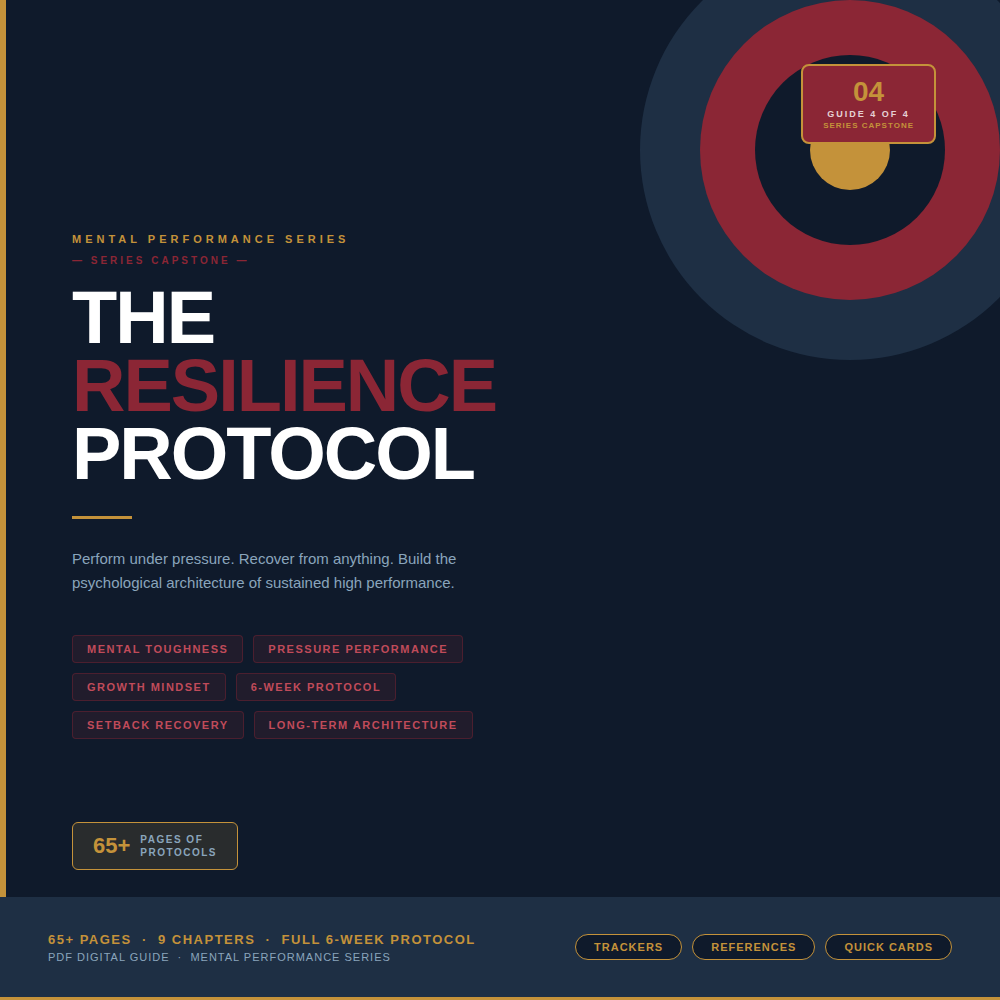
9 chapters. 65+ pages. The psychological capstone.
Chapter 1 — The Neuroscience of Resilience The resilience neural circuit: PFC-amygdala regulation, the reward system under adversity, hippocampal contextual memory. The neurochemistry of resilience: Neuropeptide Y, galanin, BDNF. How these parameters respond to training — and which practices produce measurable resilience circuit strengthening within 6–8 weeks.
Chapter 2 — Mental Toughness: Separating Myth from Mechanism The 4C model: Commitment, Challenge appraisal, Control, and Confidence. Why emotional suppression is not mental toughness — and is actively counterproductive. The neuroscience of challenge vs threat appraisal and why they produce fundamentally different physiological and performance outcomes. How each component is developed through specific practices.
Chapter 3 — Performing Under Pressure The pressure-performance relationship and the Yerkes-Dodson application. The choking mechanism and why more focused attention makes it worse. Pre-performance arousal regulation, the excitement reappraisal (Brooks, Harvard), implementation intentions, and the pre-performance routine. Post-performance recovery protocols that prevent allostatic load accumulation.
Chapter 4 — Recovery from Setbacks and Failure The four-phase setback recovery sequence. The Failure Debrief Protocol — a structured 30-minute system for converting setbacks into growth events. The shame vs guilt distinction (Tangney, Brown) and its direct implications for setback recovery quality. The redemption narrative and how to construct it authentically.
Chapter 5 — The Growth Mindset at a Neurological Level How fixed vs growth mindsets differ at the neural level — different EEG signatures, different error-processing strategies, different performance outcomes. Process over outcome orientation. The power of yet. Effort reframing. The neuroplasticity teaching intervention that makes the growth mindset credible rather than aspirational.
Chapter 6 — Stress Inoculation and Deliberate Adversity The neuroscience of stress inoculation: NPY, galanin, BDNF, and autonomic adaptations. Designing deliberate adversity exposure: physical discomfort tolerance, social exposure challenges, cognitive challenge practice, voluntary discomfort. The recovery imperative — why stress inoculation without adequate recovery produces dysregulation, not resilience.
Chapter 7 — Long-Term Performance Architecture Sustainable operating rhythms vs survivable sprints. The skill compounding principle. Energy management as a higher-order framework than time management. The role of deliberate renewal at daily, weekly, quarterly, and annual timescales.
Chapter 8 — Identity, Values, and Sustainable High Performance Identity-based motivation as the most durable motivational architecture. Values clarification for performance — the genuine inquiry beneath the aspirational framing. Purpose and meaning as biological resilience factors (Frankl, Hill). Building a resilient identity through narrative, practice, social anchoring, and values-to-behaviour alignment.
Chapter 9 — The 6-Week Resilience Protocol Complete integration: pre-protocol assessment, four progressive phases, and the daily resilience stack. Week-by-week development of biological, cognitive, emotional, and motivational resilience. Personalisation by resilience profile.
Appendix A — Trackers & Worksheets Resilience Self-Assessment (8 dimensions, Week 1 and Week 6) · Failure Debrief Template · Weekly Resilience Tracker · Pre-Performance Protocol Checklist
Appendix B — Quick Reference Cards The 8 Resilience Principles · Mental Toughness 4C Quick Reference · Pressure Performance Quick Card
—
Who This Is For
- High performers who have built strong cognitive and biological foundations and want the psychological layer that sustains them through adversity
- Anyone who performs well under normal conditions but loses ground under significant pressure, setback, or prolonged difficulty
- Leaders, executives, athletes, and knowledge workers who need genuine mental toughness — not its toxic imitation
- Readers who have completed Guides 1–3 and want the capstone that completes the Mental Performance System
- Anyone rebuilding after burnout, significant failure, or a period of sustained adversity
—
The Science Behind It
The Resilience Protocol draws on:
- Southwick and Charney’s resilience neuroscience synthesis
- Carol Dweck’s growth mindset and neural error-processing research
- Alison Wood Brooks’ excitement reappraisal research (Harvard)
- Gary Klein’s recognition-primed decision research under pressure
- Brené Brown’s shame vs guilt distinction research
- Viktor Frankl’s logotherapy and meaning-based resilience framework
- Richard Tedeschi and Lawrence Calhoun’s post-traumatic growth research
- Steven Porges’ Polyvagal Theory
- Martin Seligman’s learned optimism and resilience research
- Kristin Neff’s self-compassion research
—
What You Get
✓ 65+ page PDF — immediate download ✓ 9 chapters of resilience neuroscience and evidence-based protocols ✓ Complete 6-week progressive resilience development plan ✓ Failure Debrief Protocol — printable and reusable ✓ Pre-Performance Protocol Checklist ✓ Trackers and worksheets (Appendix A) ✓ Quick reference cards (Appendix B) ✓ Comprehensive glossary of 25 resilience science terms ✓ Guide 4 of 4 — the capstone of the Mental Performance Series
—
The Complete Mental Performance Series
Guide 1 — The Focus Protocol (available now) Attention architecture · Deep work capacity · Dopamine recalibration · Environmental design
Guide 2 — The Stress Code (available now) HPA axis regulation · Cortisol reset · Nervous system resilience · Adaptogens
Guide 3 — The Clarity Blueprint (available now) Cognitive flexibility · Decision architecture · Brain fog elimination · Clarity supplementation
Guide 4 — The Resilience Protocol (this guide) Mental toughness · Pressure performance · Setback recovery · Long-term performance architecture
The Mental Performance Bundle — all four guides available at serums.fit
—
This guide is for informational and educational purposes only. It does not constitute medical advice. Consult a qualified healthcare professional before making significant changes to your lifestyle, diet, or supplementation.
Only logged in customers who have purchased this product may leave a review.
Reviews
There are no reviews yet.