- Your cart is empty
- Continue Shopping


Product Description
The foundation you build at 15 determines the athlete you become at 25.
Youth athletes are frequently undertrained, incorrectly trained, or both. The myths that strength training is dangerous for young athletes, that early specialisation accelerates development, or that adult training programmes simply need to be scaled down — all of these produce worse outcomes than the evidence-based, age-appropriate approach this guide provides.
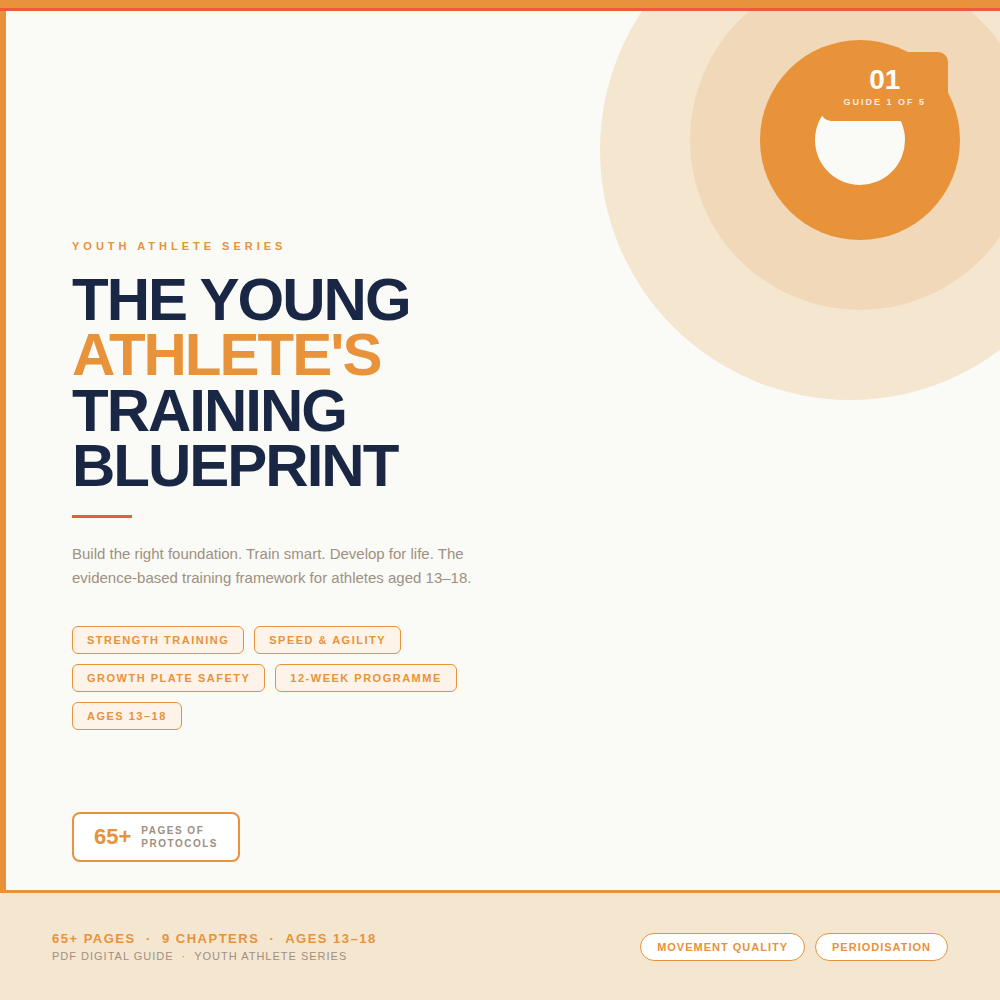
The Young Athlete’s Training Blueprint is the complete physical development framework for athletes aged 13–18 — built on the research in youth athletic development, growth physiology, and long-term athlete development.
—
What’s Inside
9 chapters. 60+ pages. Evidence-based youth training.
Chapter 1 — The Physiology of the Developing Athlete: The adolescent growth spurt and its training implications. Growth plate anatomy and vulnerability. Peak height velocity and its effect on coordination. The hormonal development window and what it means for strength training.
Chapter 2 — Strength Training for Young Athletes: The evidence that supervised strength training is safe and beneficial for youth athletes. The 4-phase progression framework from movement quality through to progressive barbell training. The key exercises and their age-appropriate progressions.
Chapter 3 — Speed, Agility, and Power: The sensitive periods for speed and power development. Sprint mechanics coaching for youth athletes. Plyometric guidelines by age group. The landing mechanics standard every athlete must achieve before plyometric training.
Chapter 4 — Aerobic Base and Conditioning: Energy system development in youth athletes. Age-appropriate conditioning methods. How to build fitness without the overtraining that adult conditioning programmes produce in developing athletes.
Chapter 5 — Periodisation Across the School Year: The four training phases around the school calendar. Managing training load during exam periods. How to use the summer break as the primary development window.
Chapter 6 — Recovery and Regeneration: Why youth athletes need more recovery than adults. Sleep requirements (8–10 hours — the evidence). Post-training nutrition made practical for teenagers.
Chapter 7 — Movement Quality and Injury Prevention: The six most common youth athlete overuse injuries and their prevention. The fundamental movement screen. ACL injury prevention for female athletes.
Chapter 8 — Sport-Specific Considerations: Training adaptations for team sports, individual sports, court sports, and combat sports. The multi-sport development evidence.
Chapter 9 — The 12-Week Foundation Programme: Complete session plans for all three phases. Sample weeks. Assessment and tracking protocols.
Appendices — Full exercise library; assessment cards; tracking templates; wellness monitoring
—
Also Includes
✓ Complete session plans for all 12 weeks ✓ The injury prevention warm-up programme (FIFA 11+ adapted) ✓ Age-appropriate exercise progressions table ✓ Sprint and agility drill library ✓ Parent’s guide to strength training safety ✓ Strength standards by age ✓ 12-month training calendar ✓ Guide 1 of 5 in the Youth Athlete Series
—
For informational and educational purposes only. Youth athletes should always train under qualified adult supervision.
Only logged in customers who have purchased this product may leave a review.


Reviews
There are no reviews yet.